Wednesday, 31 May 2023

New IELTS Speaking test in Pakistan – May 2023

IELTS Speaking Latest Questions Pakistan May 2023

Thanks to the kind IELTS tutor KA from Pakistan, today we are sharing the Speaking questions from his student’s IELTS exam:

Speaking test

Part 1 (Interview)

– What is your full name?
– Where do you live?
– Do you work or study?
– Are you passionate about your job?
– What tools help you in your job?
– How many hours do you work in a week?
– Do you like watching animals? Why or why not?
– Have you ever visited the zoo? Why or why not?
– Do you like to see animals in the zoo?

Part 2 (Cue Card)

Talk about a time when you received some incorrect information. You should say

– what the information was and where you got it
– why you needed it
– how you found out it was incorrect
– and explain what you did after finding out the information was incorrect.

Part 3 (Discussion)

– What kind of jobs require providing information to people?
– What skills or qualities do people need to be able to provide information?
– Do some people have more correct information that others?
– What does ‘transparency’ mean to you?
– How can we find the correct information?
– Do students rely more on facts than correct information?
– What is more important for students, facts or correct information?


https://ift.tt/2ShrDyq
from IELTS-Blog https://ift.tt/vCm4PbK
via IFTTT

Tuesday, 30 May 2023

IELTS Report, topic: Line graph describing production of 3 different fuels in the UK

IELTS Academic Writing Task 1 Line Graph Model Answer Band 8

This is a model answer for an Academic Writing Task 1 from the IELTS exam in Pakistan, shared recently. This response is likely to get Band 8 or 8.5 in IELTS.

You should spend about 20 minutes on this task

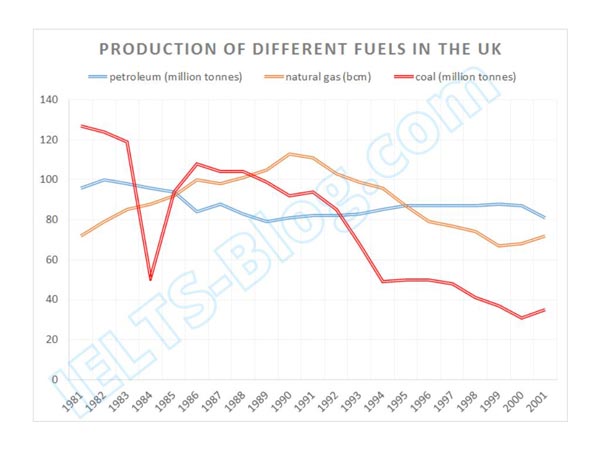
The line graph below describes production of different fuels in the UK from 1981 to 2000. Summarise the information by selecting and reporting the main features, and make comparisons where relevant.

Write at least 150 words

IELTS Writing Task 1 Line Graph Different Fuels Production in UK

* Note: this isn’t the actual graph given in the test, it was recreated for the purpose of demonstration.

Band 8.5 Model Answer

The line graph gives information about the production of coal, gas and petroleum in the UK from 1981 to 2001.

It is clear from the graph that there was a decline in the production of all three types of fuel over the given time period, especially coal.

To begin, coal started out with the highest value of 127 million tonnes produced in 1981, and then plummeted to 51 million tonnes in 1984. Thereafter, the ratio recovered significantly to 106 million tonnes in 1986. From then onwards, the ratio has been consistently declining and eventually reached a low of 35 million tonnes in 2001.

The production of petroleum showed a slight increase from 96 to 100 million tonnes at the very start of the period. From 1983, there was a gradual decrease in production to a low of 79 million tonnes in 1989. Later on, from 1991 to 2001 the numbers remained relatively stable, between 80 to 87 million tonnes.

Natural gas production started at 72 bcm and increased for almost 10 years, reaching the high of 113 bcm in 1990. That point marked a start of gradual decline of around 5 bcm per year, to the low of 67 in 1999. Thereafter, there was a slight recovery to 72 bcm in 2001.

Click here to see more IELTS reports of band 8


https://ift.tt/JXpS3VE
from IELTS-Blog https://ift.tt/9Ny2TgE
via IFTTT

Monday, 29 May 2023

IELTS test in Uzbekistan – May 2023 (Academic Module)

IELTS Academic Latest Questions Uzbekistan May 2023

Thanks to our kind subscriber D we are sharing the questions from the IELTS exam she took two days ago in Uzbekistan:

Writing test

Writing task 1 (a report)

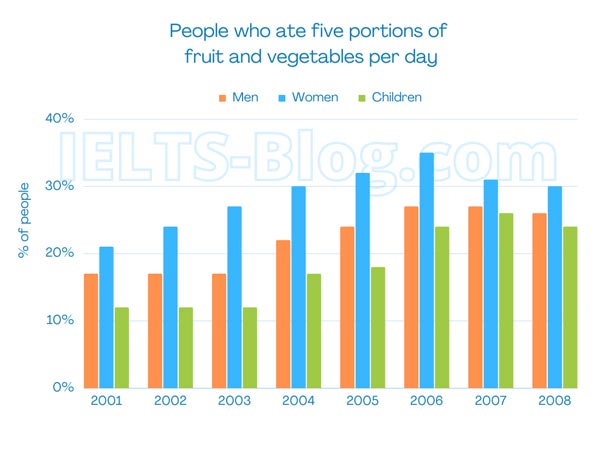
The chart below shows the percentage of people in the UK who ate five portions of fruit and vegetables per day between 2001 and 2008.

Summarise the information by selecting and reporting the main features, and make comparisons where relevant.

IELTS Writing Task 1 Bar Chart Table People Who Ate 5 Portions of Fruit and Vegetables in the UK
* Note: this isn’t the actual chart given in the test, it was recreated for the purpose of demonstration.

Writing task 2 (an essay)

If people could choose between working and not working, they would choose not to work. To what extent do you agree or disagree with this statement?

Give reasons for your answer and include any relevant examples from your own knowledge or experience.

Speaking test

Part 1 (Interview)

– What is your full name?
– What can I call you?
– Do you work or are you a student?
– What do you like about your studies?
– Did you buy a lot of bags when you were young?
– Do you often take a bag with you when you go out?
– What type of bags do people take when they go on holiday?

Part 2 (Cue Card)

Describe a job that you think is interesting. You should say

– what job it is
– how you learnt about it
– what skills are required for this job
– and explain why you think this job is interesting

Part 3 (Discussion)

Unfortunately D didn’t remember the questions in Speaking Part 3.


https://ift.tt/QMow3jL
from IELTS-Blog https://ift.tt/SPXyTtV
via IFTTT

Sunday, 28 May 2023

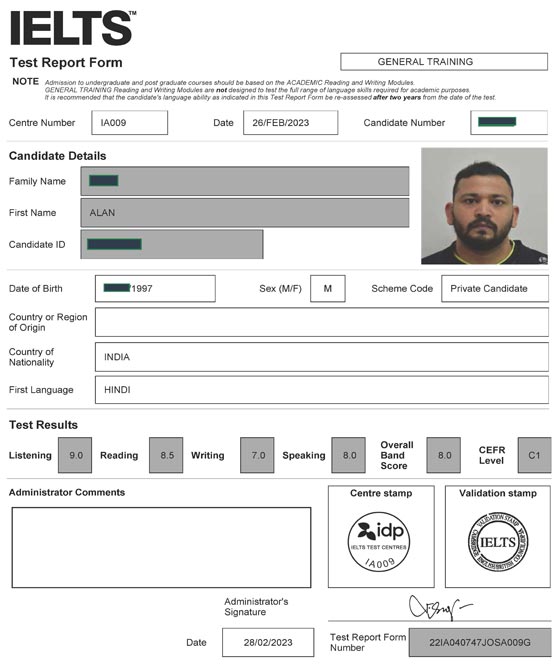
Here is what helped Alan get Band 8 in IELTS

You probably remember Alan as one of the IELTS Results competition winners. We celebrated their success earlier this month, and Alan took the first place in the General Training group.

Alan lives in India and speaks Hindi as his first language. He came across IELTS-Blog.com and subscribed to our daily emails in January this year. When he took the test, he scored Band 8.0, and decided to take part in our monthly IELTS results competition. As a winner, Alan was invited to share his experience, and he wanted to give back and help everyone still studying for the test. Here is what Alan told us about his IELTS preparation, and how you can do well in the test:

“My English proficiency before starting the preparation was at a moderate level, I would say.

With the initial practice assessments I took, I was around Band 7-8 in Listening and Reading, Band 5-6 in Writing, and an estimate of Band 6 in Speaking (based on feedback I received). My weaknesses were writing and speaking, so I concentrated my 2 months of prep on those more than the other sections. I dedicated around an hour a day to preparation.

Some general tips that I found helpful:

– Practice consistently: fix a time in the day (I fixed a time after work to study).

– Book the test in advance when you feel like you are moderately ready. This gives a deadline and a reason to study. Dragging out the preparation might reduce your motivation and confidence.

– Go through the free materials provided when registering for the exam.

– Read the IELTS-blog daily emails

– Focus on your weaknesses

– Do not underestimate the difficulty of the exam. One of my friends (who has better English proficiency than me) ignored the writing letter/essay structure and got Band 6 in the test.

– Take mock tests for Reading and Listening online on websites like IELTS-Blog.com to familiarise yourself with the computer-based interface.

– Keep the IELTS assessment criteria in mind while doing tasks

– Track your Listening and Reading practice scores

I hope you found some of my tips useful.”

Thank you very much, Alan, for sharing your advice, and we wish you only the very best!


Best IELTS test result April 2023


https://ift.tt/O9xnU5X
from IELTS-Blog https://ift.tt/g5rktc4
via IFTTT