Monday, 31 October 2022

IELTS test in India – October 2022 (Academic Module)

Our kind friend S.R. took IELTS in India very recently and remembered the following questions:

Writing test

Writing task 1 (a report)

The table below gives information about international tourism to 8 different countries in 2009 and 2010.

Summarise the information by selecting and reporting the main features, and make comparisons where relevant.
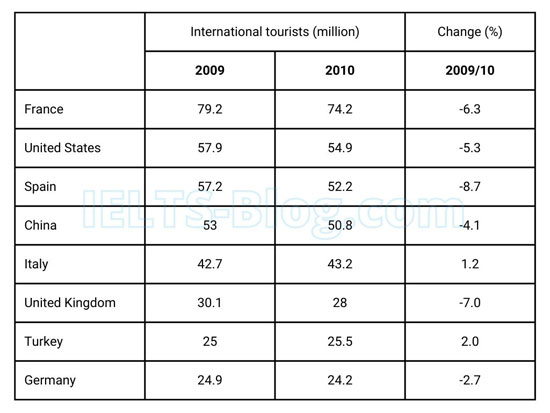
IELTS Writing Task 1 Table International Tourists

* Note: this isn’t the actual table given in the test, it is provided for demonstration purposes.

Writing task 2 (an essay)

Newspapers have a significant influence on people’s ideas and opinions. Why is this happening? Is it a positive or negative situation?

Speaking test

Part 1 (Interview)

– What is your full name?
– Where do you live?
– Do you work or study?
– Do you like the subjects you are studying?
– Do you like sports?
– What do you like more, watching or playing sports?
– With whom do you usually watch or play ports?
– Is there a sport you would like to play in the future?
– Do you keep things instead of throwing them away?
– Which items do you usually keep? Why?

Part 2 (Cue Card)

Describe something that helps you concentrate. You should say

– what it is
– when you do it
– how it helps you
– and explain why you need it to concentrate.

Part 3 (Discussion)

– Why is concentration required?
– Which professions require more concentration than others?
– Do children need to concentrate?
– Why do people struggle with concentration these days?
– How can people improve it?
– What can companies do to improve their workers’ concentration?


https://ift.tt/vIAGzMx
from IELTS-Blog https://ift.tt/CzO0yHx
via IFTTT

Sunday, 30 October 2022

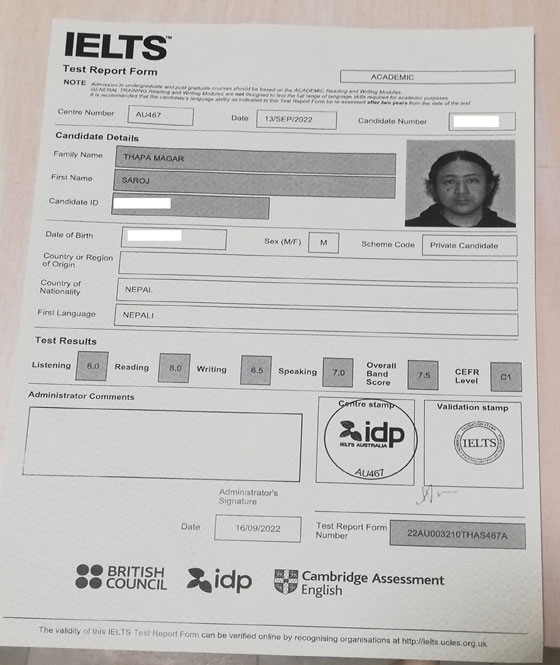
The lessons Saroj learnt on his IELTS journey to Band 7.5

You may remember Saroj as one of our IELTS Results competition winners, whose success we celebrated earlier this month. Saroj is a young man from Nepal who recently took an Academic IELTS test and got Band 7.5.

According to our tradition, Saroj was invited to share his experience preparing for the test, and you will find that the lessons he learnt in his preparation for IELTS can be useful to anyone studying for the test. Bonus tip: take note of the things he skipped but wished he had done, because YOU still have time to include them in your preparation sessions!

“I am writing to thank you for this website which has helped me immensely in my preparation for IELTS academic test which I have just completed and haven gotten back the results. Honestly, I used free resources from your website and others, and am genuinely in disbelief still that I did well.

Basically, the way I prepared was to practice the materials available on the website as much as possible. For writing, I would try to actually write an essay before reading the sample answer for that essay question or at least to have brainstormed ideas prior.

For reading, I would read through the questions first before actually reading the passages, in anticipation of the possible matching of the themes of the passage to a question.

I honestly feel I was inadequately prepared for the speaking section as I did not prepare for it much, but speaking out loud my answers prior to looking at the answers would be helpful.

The same strategy for the writing task 1 so generally, practising and testing ourselves prior to looking at the answers as compared to simply looking at the model answers would definitely make a difference. I suppose practising under time constraints would have helped me further in my preparation.”

Thank you very much, Saroj, for sharing your advice, and we wish you only the very best!


Best IELTS test result September 2022


https://ift.tt/CH6W5yM
from IELTS-Blog https://ift.tt/t3USXiC
via IFTTT

Thursday, 27 October 2022

IELTS Speaking test in Pakistan – October 2022

Our friend K.C. took IELTS in Pakistan and remembered the Speaking questions we’re sharing today:

Speaking test

Part 1 (Interview)

– What is your full name?
– Can I see your ID?
– Do you study or work?
– Where do you study?
– What type of shoes do you wear?
– What is your favourite color for shoes?
– Do you often buy shoes in this colour?
– How often do you buy new shoes?
– When did you last buy a pair of shoes?

Part 2 (Cue Card)

Describe a language that you think will become an international language in the future. You should say

– what the language is
– where the language is spoken
– when you think it will happen
– and explain why you think it will become an international language.

Part 3 (Discussion)

– Why do people choose to learn a new language?
– What problems are often associated with learning a new language?
– Why do you think learning a new language is easier for some people, but harder for others?
– Do you think people visiting a country as tourists should learn its language?


https://ift.tt/w6keran
from IELTS-Blog https://ift.tt/tT3eZpB
via IFTTT

Wednesday, 26 October 2022

IELTS Report, topic: Two bar graphs showing how often people exercised in Europe in 2016

This is a model answer for an Academic Writing Task 1 from the IELTS exam in Taiwan, shared yesterday. This response is likely to get Band 8 or 8.5 in IELTS.

You should spend about 20 minutes on this task

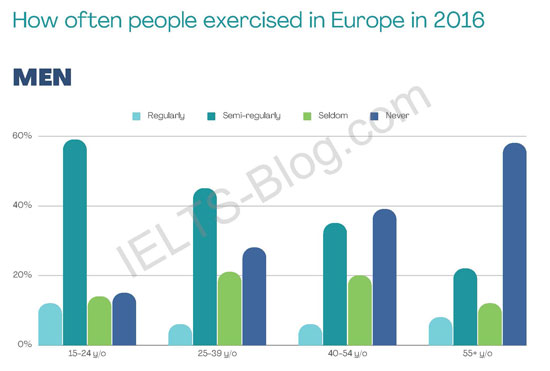
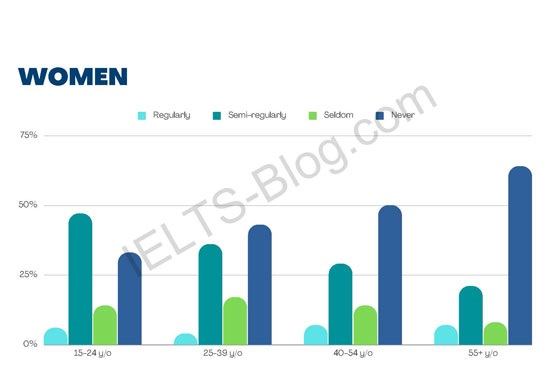
The graphs below show how often people exercised in Europe in 2016, by age group and gender. Summarise the information by selecting and reporting the main features, and make comparisons where relevant.

Write at least 150 words

IELTS Writing Task 1 Bar Graph Men

IELTS Writing Task 1 Bar Graph Women

Band 8.5 Model Answer

The bar graphs describe the frequency with which men and women in Europe engaged in physical activity in 2016. The participants are split into 4 age groups (15-24, 25-30, 40-54 and 55+ years old) and the data is presented in percentages.

It can be clearly seen that for both men and women regularity of exercise dropped with age, and the percentage of people who never engaged in physical activity increased, peaking in the oldest age group.

Taking a closer look at men, the highest percentage (60%) of the youngest men aged 15-24 exercised semi-regularly and the rest were split into almost equal shares, with 12% exercising regularly, 13% seldom and 15% never. In the other age groups, regular exercise was the least common at roughly 7%. Exercising semi-regularly was the dominant proportion in the 25-39 year old group at 43%, and the shares of people who seldom or never exercised were quite close at 20% and 27% respectively. Most of the 40-54 year olds either exercised semi-regularly (36%) or not at all (39%). In the oldest age group only 21% exercised semi-regularly and the vast majority (nearly 60%) didn’t train at all.

Compared to men, women engaged in physical activity less, with only about 37% of the youngest age group doing semi-regular exercise and 27% avoiding physical activity. It was rare for women of all ages to exercise regularly, as only 2%-4% did it. In the 25-39 year old cohort the proportions of women doing sports semi-regularly and never were very close, at 37% and 45% respectively. Half of the 45-54 year olds never exercised and only 26% trained semi-regularly. The 55+ year old women were most likely to never exercise (63%) and just about 18% being physically active semi-regularly.

Click here to see more IELTS reports of band 8


https://ift.tt/iPyxsoN
from IELTS-Blog https://ift.tt/dRAOJLY
via IFTTT