Tuesday, 3 March 2020

IELTS Speaking Band 6 Full Test Video with Examiner’s Feedback

It’s not too hard to estimate your IELTS score in Listening or Reading – all you need to do is take a practice test and count how many correct answers you had. But how do you find out your score in Speaking? Here’s a hint: you need to get someone to help you, which is exactly what Arun in this video is doing. And it’s a good thing he got an early Speaking assessment, because his Speaking score turned out to be Band 6, which is lower than the score he needs. So this experience saved Arun from taking the IELTS test too early and wasting his money, and he also received a list of things to work on, plus suggestions how to deal with his weaknesses and increase his score.

In the video you’re about to watch Arun, an IELTS test taker from India, is answering typical IELTS Speaking questions. You can see the breakdown of his score by 4 IELTS criteria (Fluency and Coherence, Lexical Resource, Grammatical Range and Accuracy, and Pronunciation) at the end of the video, and also in his evaluation report here.

The questions are shown on the screen while Arun answers them. You will see that every question has a number (Q1, Q2, etc) and the examiner in his evaluation report is referring to Arun’s little mistakes in every question. It’s great to watch the entire video first, and then go back to the specific questions as you read the evaluation report. It will help you understand what exactly the examiner means when he says something like

Q7 – ‘as well as’ not used correctly: ‘we can go by bus, as well as we can go by car’ should be: ‘we can go by bus as well as by car’’; ‘why I like this restaurant’ should be followed by the verb ‘to be’ – ‘why I like this restaurant IS because’.

Download Arun’s speaking evaluation report here

It would be a good exercise for you to make a list of any mistakes or inaccuracies you hear while watching this video, and then compare your notes to the examiner’s feedback. What would you do better? What vocabulary could you use instead?

Try and answer the same questions in your own words, and perhaps even record yourself. It will provide an opportunity to listen to your pronunciation and see what needs work.

If you’d like to get your Speaking evaluated just like Arun did, you can – go here to learn how.


https://ift.tt/1yra8oP
from IELTS-Blog https://ift.tt/2IiU55y
via IFTTT

Thursday, 27 February 2020

IELTS essay, topic: Some people believe that women should be treated as equal to men when applying for a job with the police or the military, while others disagree (opinion)

Some people believe that women should be treated as equal to men when applying for a job with the police or the military. Others think that women are less suitable for this kind of job. Discuss both views and give your opinion.

Sample Essay

In recent years gender equality in employment has been the topic of heated debate. While some may argue that women are less suited for certain jobs such as with the police or the military, I believe that female candidates should be treated the same as their male counterparts.

Those who consider women to be unsuited for some kinds of jobs including the police or the military often hold that opinion because such jobs are extremely physically demanding. As the female body has smaller muscles and less physical strength compared to male body, women may have difficulty engaging in strenuous activity which can be exhausting even for men. In military service, female soldiers are more likely to struggle while defending themselves than their male peers when they are forced to move around carrying heavy firearms in the battle, which can increase their risk of mission failure. Because of the hazards and extreme conditions they may encounter, some people advocate that women are not suitable for work in these fields.

Nevertheless, I believe that female applicants should be considered for police or military placements without a gender bias, because women are more suited to certain tasks. In the police service, female officers can perform important roles on some occasions such as a body search where male officers are restricted from touching female convicts. In the military service, female nursing staff are more likely to care better for injured soldiers since maternal instinct makes them dedicated and heart-warming professionals. Furthermore, for the sake of fairness to all, job seekers should have an equal opportunity to choose their jobs freely, regardless of gender. Many women have the desire to work in the police and the military and some of them have relevant expertise and qualifications. Therefore, they should not be discriminated against in employment opportunities for these jobs.

In conclusion, although some say that women are incompatible with police and military duties because of the high physical demands, I believe that they should be treated as equal to men. This is because there are certain roles with the police and the military that are more suitable for women than men, and therefore both genders should have equal employment opportunities.

Click here to see more IELTS essays of Band 8


https://ift.tt/1yra8oP
from IELTS-Blog https://ift.tt/3830Gvu
via IFTTT

Wednesday, 19 February 2020

Top 8 English Pronunciation Problems for Japanese Speakers (and how to fix them!)

If you are a native Japanese Speaker, you may be facing a frustrating issue on a daily basis. You say something to someone, and they say…

– ‘I beg your pardon?’
– ‘Say that again?’
– ‘Pardon?’
– ‘Sorry?’

Or they just stand there staring at you. If this situation is familiar, then your pronunciation might need some work.

The Top 8 English Pronunciation Problems for Japanese Speakers

There are some sounds in English that are more difficult for Japanese Speakers to pronounce properly. Here are some typical pronunciation errors Japanese Speakers tend to make.

1. Confusing consonants ‘l’ & ‘r’

Sometimes native Japanese speakers say ‘r’ instead of ‘l’.

Check: do you say ‘comprete’ instead of ‘complete’?
Listen to the correct pronunciation here.

2. Pronouncing consonants ‘f’ and ‘v’ incorrectly

Sometimes Japanese speakers say ‘p’ instead of ‘f’, such as ‘preper’ instead of ‘prefer’.
Listen to the correct pronunciation here.

Another common issue is using ‘b’ instead of ‘v’, for instance saying ‘bideo’ instead of ‘video’.
Listen to the correct pronunciation here.

3. Pronouncing the consonant ‘th’ incorrectly

Sometimes speakers of Japanese might say ‘sink’ instead of ‘think’, or ‘sick’ instead of ‘thick’. That changes the meaning of the word entirely and the listener would struggle to understand them.

Listen to the correct pronunciation here.

4. Vowel /oʊ/ like in ‘note’

If you pronounce ‘note’ more like ‘not’, that’s incorrect – it needs to be pronounced like ‘nowt’.
Listen to the correct pronunciation here.

The word ‘most’ has the same sound /oʊ/.
Listen to the correct pronunciation here.

5. Vowel ‘er’ /ɜː/ like in ‘hurt’

If your ‘hurt’ sounds more like ‘heart’, and ‘firm’ more like ‘farm’, that is incorrect.
Listen here to both incorrect and correct pronunciation, and fix your own, if you need to (scroll down to the blue box to listen).

6. Vowel /æ/ like in ‘hat’

If you say ‘hat’ but it sounds like ‘hut’, or ‘back’ sounds like ‘buck’, that is another problem.
Go here to listen to the correct and incorrect pronunciation, and you will see the difference (scroll down to the blue box to listen).

7. Word stress

Each multi-syllable word in English has one stressed syllable. In the word ‘rePORT’ the stress is on ‘PORT’, so you should say it in higher pitch and put more emphasis on it. When you don’t, it makes your word stress and rhythm flatter than a native speaker’s.

8. Weak vowels

Japanese speakers pronounce every vowel in English the same way – but some vowels should be pronounced differently. A good example of a weak vowel is ‘o’ in ‘today’ – it should be pronounced more like ‘uh’ rather than ‘o’. Listen to the correct pronunciation here.

How to fix Japanese Speakers’ pronunciation problems

One thing I learnt from Georgie Harding, the founder of SpeechActive and experienced speech pathologist, is this:

“Your journey to a better pronunciation starts with awareness.”

You need to become aware of problems in your pronunciation first, and then you can start fixing them. Georgie has worked with hundreds of Japanese speakers and created a very useful resource to help you achieve improvement quickly and easily.

What you need to do is:

1. Go here and read through the pronunciation problems checklist.

2. Scroll down to grey and blue boxes.

3. Read about the problem and how to fix it in a grey box.

4. Listen to the Japanese speaker in the blue box. Do you hear the problem sound?

5. Listen to the native English speaker in the blue box. Do you notice the difference in pronunciation?

6. Record your speech using the voice recorder on the web page, and play to listen. Are you making the sound correctly?

These are the steps that will help you fix your pronunciation. The problem sounds may be there now, but you will learn to hear them, and to make them correctly. Regular practice will help you get very close to a native English speaker’s pronunciation.

If you need help with your pronunciation, Georgie is the best person to talk to (and you can contact her here). She worked with so many Japanese professionals and students, living in the UK, the US, Australia and of course Japan, and she has a pronunciation course designed specifically for Japanese speakers. So if you need some English pronunciation training, or accent reduction, Georgie will definitely help you speak English more clearly. Read more about her pronunciation course for Japanese speakers here.


Special offer for IELTS-Blog.com visitors

If you decide to enrol in any of Georgie’s pronunciation courses, we got you a special 30% discount, available exclusively from IELTS-Blog.com:

IELTSblogsave30%

Just to clarify – this discount is for ALL our readers to enjoy (not just Japanese Speakers), and will work for any pronunciation courses on SpeechActive website.

Enter this code at checkout on SpeechActive website, and use the savings to reward yourself for making a very, very smart decision today!


https://ift.tt/1yra8oP
from IELTS-Blog https://ift.tt/2SF8j6V
via IFTTT

Tuesday, 18 February 2020

How dedication and consistency can get you Band 8 in IELTS

Band 8 in IELTSSo, what does it take to get Band 8 in IELTS?

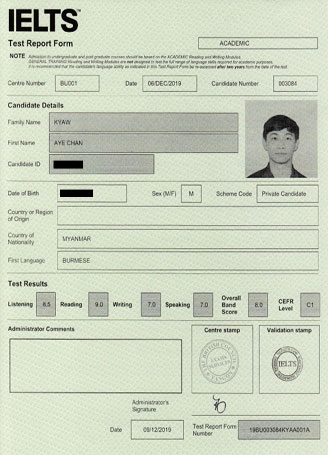
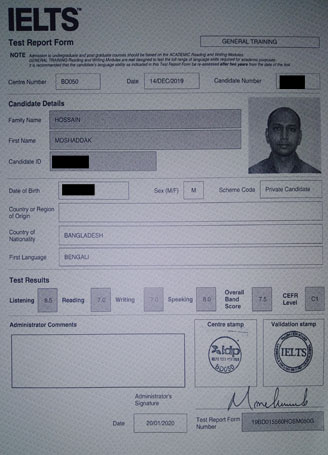
Aye Chan and Moshaddak say, “Dedication and consistency”, and we can trust their experience because they received IELTS Overall Band Scores of 8 and 7.5 respectively in their recent exams. As winners of our monthly results competition they were invited to share their tips and advice, and here is what they said:

Aye Chan, the owner of IELTS Overall Band Score of 8.0, said:

“Hello everyone,

I would like to advise you guys to keep in mind that IELTS scores are hugely influenced by your English language level. After all, it is a standardized language test. As for me, I prepared for IELTS for 2 months with a daily study routine of 3 hours. I cannot stress enough how important your English skills are. However, if you are someone with weak foundation like me, there are very good resources out there for you.

First, you have to decide between Computer-based and Paper-based IELTS, because it will largely affect how you prepare. For me, I took the Computer-based exam. The one thing that I used were online mock tests. It was very helpful; I got two reading paragraphs with different questions from mock tests in the actual exam. Another thing is that I read IELTS-Blog.com posts every day for up-to-date recent questions and tips for all four skills. They are fantastic, especially the writing tips and stand out among others. In addition to this, the recent questions are very useful in preparation for the Speaking test as you can build your ideas bank from it. Last but not least, I would like to say thanks to my local IELTS coaches (Teacher May Pyae Phyo Thu and Teacher Eaintme) for guidance.

That is pretty much all I did. One more thing to keep in mind is that you really need to have a strong dedication and consistency during exam preparation. Do not take the test for granted, but think of passing it as your dream. This was a crucial aspect, at least for me. I wish all the best to my fellow IELTS Warriors. Cheers!”

Band 8 in IELTS

Moshaddak, the owner of IELTS Overall Band Score of 7.5, said:

“Thanks for choosing me a winner.

I would like to suggest candidates to make a study plan and remain patient until they obtain the desired score. Generally, I used to listen on the radio to a variety of English conversations to develop my listening skills. For reading, I would advise to read texts on a wide range of topics, and focus on skimming and scanning techniques. Also, students need to write every day to develop their writing skill. Here, they should take advice from experts and find out ways to overcome their weakness. In my case, I used writing correction service from IELTS-BLOG.com which supported me in a great way, and especially helped to improve my grammar, lexical resource, and ability to write complex sentences.

For speaking, I would suggest to find a partner and practice regularly – but everyone should evaluate their speaking to find out their weaknesses.

Overall, my experience with IELTS-BLOG.com is overwhelming and I thank them for their support.”

Band 7.5 in IELTS


https://ift.tt/2J0QBGf
from IELTS-Blog https://ift.tt/38PhJlO
via IFTTT