Wednesday, 14 October 2020

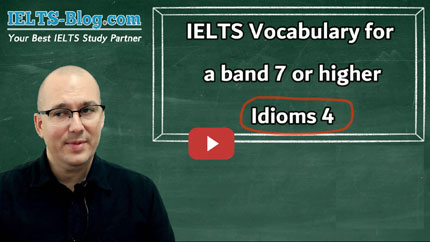
10 expressions to help you get Band 7+ in IELTS (Lesson 4)

You may have already learnt the idioms from Lesson 3, and well done if you have! But even if you only joined us now, it’s all good – you can start from any lesson, as they are all useful, and catch up later on the lessons you missed.

Why use idiomatic expressions in IELTS Speaking or Writing? Because they help you get a higher score. In these vocabulary lessons we introduce some idioms you could use, and teach you how to use them appropriately.

In today’s lesson video Adam, an ex-IELTS examiner with 10 years of experience, gives you 10 more excellent idioms to use, to get a Band 7 or higher score in your IELTS Speaking or Writing test. Adam explains what every expression means and how to use it in a sentence.

Click here to start the lesson and do a quick quiz

In the lesson click “Watch” to watch the lesson and then click “Think” to answer 10 questions on it.
If you make a mistake, the lesson will take you to the correct answer in the video. Video hints work on desktop computers, on mobile devices you will just see the correct/incorrect answers.

IELTS Vocabulary Lesson 4

If you’d like to copy and save these useful expressions for later, here is a list, have a look at the idioms below and ask yourself two questions:

Question 1. Do you know what they mean?
Question 2. Can you use them in a sentence?

And then make a sentence about YOU and use one of those expressions. By doing that you are more likely to remember that idiom, because we tend to remember personal things better!

Go here to check YOUR own Speaking score.

10 expressions to help you get a Band 7 in IELTS

1. To be on the ball
2. To pull someone’s leg
3. To pull yourself together
4. So far so good
5. To be the last/final straw
6. The best of both worlds
7. Time flies when you’re having fun
8. To get bent out of shape
9. To make matters worse
10. To be under the weather


https://ift.tt/31aamE1
from IELTS-Blog https://ift.tt/3lMlezF
via IFTTT

Wednesday, 7 October 2020

IELTS essay, topic: In the modern world it is possible to shop, work and communicate online without face-to-face contact, is it a positive or a negative development?

In the modern world, it is possible to shop, work and communicate with people via the Internet and live without any face-to-face contact with others. Is it a positive or negative development?

Sample Band 8 Essay

The feasibility of shopping, working and communicating through the Internet is gradually eliminating the necessity of in-person encounters. I believe the merits of this opportunity outnumber its demerits and the lowered volume of traffic in addition to the possibility of long-range communication will be discussed as reasons for this claim in this essay.

One chief benefit of using the Internet as a means of making purchases, working and communicating would be the lowered demand for transport, through eradicating the need for face-to-face contact. Such decreased volume of transportation would result in fewer harmful gas emissions which could significantly contribute to creating a cleaner environment. Furthermore, reduced commuting burden yields more free time for individuals. It could be spent in various ways such as working, studying and socialising with family and friends to name a few, which would be more productive and enjoyable.

Another key merit of using the Internet would be the emergence of state-of-the-art telecommunication applications. These technologies have made it possible for those with access to the Internet to get in touch and send and receive audiovisual content by pushing just a few buttons. This presents a stark contrast to the situation only a few decades ago, when long-distance communication was possible solely through paper-based letters, which could possibly take months to reach the recipient.

There are, however, some drawbacks to online communication, in particular the possibility that the lack of contact brought by technological advancements could potentially weaken human bonds. Taking into consideration that humans are sociable species, this could pose a dire threat to our mental health. This predicament, however, would be mitigated by the extra free time technological developments create for us. This free time could be spent with friends and family and in the long run would strengthen our relationships and improve our emotional wellbeing.

To recapitulate, the Internet’s demolishing the need for person-to-person contact brings about numerous benefits. A more sustainable environment as well as more free time generated for individuals, a reduced need to commute in addition to the feasibility of conducting long-distance communication in the easiest way possible, are all instances of the above-mentioned merits.

Teacher’s comment: The candidate displays a clear understanding of the task. The ideas are organized logically by following a clear progression in most parts. The range of vocabulary is wide and precise, and most sentences are free from grammatical errors. Overall, this is a very good essay and seems worthy of Band 8 or 8.5.

Click here to see more IELTS essays of Band 8


https://ift.tt/1yra8oP
from IELTS-Blog https://ift.tt/34syFxK
via IFTTT

Sunday, 4 October 2020

IELTS for people with disability

IELTS is well known for being a time-intensive test, because there is so much to do and so little time to do it. This presents a problem even for native English speakers, who can read and write quite fast, so it isn’t surprising that students with English as a second language struggle even more. But there is a large cohort for whom IELTS is even more challenging, and that is people who live with a disability that affects the way they read, write, speak or hear.

Anne D., as a person who has difficulty using her hands, faced many problems while taking the IELTS exam. She is a true champion, and because of her amazing determination and resilience she got Band 8 in the test – but to get there she had to go through a lot. In this blog post she is telling her story, to help others avoid obstacles that got in her way.

Anne D. wrote in an email,

Band 8 in IELTS“I am a disabled person, a quadriplegic who has difficulty using all four limbs, and that’s why I require more time than the other candidates to write or type. I live in New Jersey, USA. I took the IELTS test for Academics on September 19, 2020 at Manhattan, New York. I faced a lot of challenges when I asked for extra time and I thought I would document my experience so that other disabled students won’t have to face the same problems that I faced.

When I registered for the test in the month of August, the official website gave me two options in New Jersey – one was for a Paper Based Test (PBT) and the other one was a Computer Delivered Test (CDT). The PBT test center was defunct and anyways my first option was to go for the CDT so I chose Newark and registered for October. The website didn’t give me an option to ask for extra time at the time of registering.

After this started a spate of frantic emails and calls to British Council, British Council USA and IELTS USA. I even posted on their Facebook pages. They had the same answer “Sorry, we can’t help you. Please contact your test center.”

So, I called and emailed my test center and they replied after a few days. They redirected me to a test center in New York saying that it wasn’t possible to deliver a CDT with extra time. I was told that I would get a full refund if I cancelled my test well in advance but they deducted $60 from the registration fees when I cancelled the test at Newark.

The test center at Manhattan offered only PBT but there was an option to opt for extra time as well as ask for a word processor while registering so I selected that but the center informed me that to take up a CDT with extra time, I needed to give at least 3 months’ notice to the board. This places a highly unfair restriction on the candidate as University application deadlines don’t allow for that kind of a time frame. Also, the process for obtaining extra time involves a lot of email communication that is time consuming. I had to send a medical certificate not older than a year for the board’s consideration and they took a few weeks’ time to get back with an answer. Finally, they approved me for 25% extra time which was sufficient for me but I had to go through the stress of practicing my handwriting. My handwriting is not legible due to my disability and the whole process caused me a lot of unwanted stress.

While the test center made all possible efforts to accommodate my special request, I was disappointed that I couldn’t take the computer based test as extra time was allowed only while writing the paper based test.

It would be great if the IELTS board can make the process of obtaining extra time for disabled candidates more straightforward (for example, they can give a provision to upload medical certificates while submitting the IELTS application just like they ask for ID) and allow for extra time on a computer based test. They should also make the whole process quicker.

My advice to those who are disabled:

1. Keep a medical certificate explaining your disability handy. It should not be more than a year old.

2. Email and call your test center well in advance.

3. Time. You need a lot of time. Book your test at least 6 to 8 months before your deadlines.

4. Remember that the results take time too, so you need a buffer for that too.

5. Practice writing on paper just in case you’re forced to take the PBT like me. “


https://ift.tt/2GriNU5
from IELTS-Blog https://ift.tt/3cWyvSW
via IFTTT
Thursday, 1 October 2020

Two successful students explain what it takes to get Band 7.5 or higher in IELTS

Sometimes the inspiration you need to achieve your dreams can be found in a few simple words of wisdom, and that is exactly what we have for you today. We would like you to meet two winners of our monthly IELTS results competition, because there is a lot you can learn from their experience.

Kourosh Moini lives in Iran, he is a native Farsi speaker who got Band 7.5 in Academic IELTS. When we asked Kourosh how he scored so well, he said:

“In my experience, knowing where your strengths and weaknesses are is the best guide you can have. So the first step is to identify those and be truly honest with yourself. I achieved this simply by taking standard practice tests at home. After 3 tests, I recognized very clearly where my skills came short and needed improvements.

Then you can parcel the issues and come up with a solution. In my case, my strength is listening and my weakness was writing. So, I started searching for information on how to improve my writing skills and I found out that collocations and the ability to write in the appropriate structures are of great importance. Then, I studied this book called “Collocation in use” by Cambridge publications that helped me a lot and started watching some online courses on how to use the appropriate structure in regard to various writing questions.

I can also recommend, when practicing your reading skills, pay attention to how native authors paraphrase a concept because it is very useful. This can fix many errors in this section and it gives you the ability to imitate native authors’ styles when writing your own material.

In www.IELTS-Blog.com there are many speaking questions from actual recent IELTS tests – that can be very effective and helped me a lot to prepare for my speaking session with the help of a dear friend. Actually, Part 2 of my speaking was somehow similar to a previous test I found on IELTS-Blog.com.

Hope what I wrote helps others and wish you all the best possible results in your IELTS exams.”

Amir Ebrahimi also lives in Iran; he got Band 8.0 in General Training IELTS. When we asked him what others could do to increase their IELTS score like he did, he put together quite a few handy tips:

Band 8 in IELTS“Firstly, I suggest that candidates increase their connection with the language they are trying to learn. To do so, I used to listen to at least 10 podcast channels with varied accents. In addition to that, I switched my bedtime reading from Farsi to English. I also used to watch TV series with English subtitles to improve my reading comprehension and listening at the same time. All in all, you shouldn’t miss any chance to be a professional English consumer 🙂 .

Secondly, I was wrong thinking that I can get the required score purely by self-study, which led me to fail in 3 exams in a row. That was when I started to consult with IELTS teachers and successful candidates to get familiar with my weaknesses and get feedback on my essays and speaking skills. Therefore, I asked a local teacher for help with the writing section and bought the writing correction service from IELTS-Blog.com to have my essays revised by a native IELTS expert. During my preparation, I had collected all the mistakes I was made aware of, and reviewed them the day before the exam to avoid repeating them. Therefore, do not forget to ask an expert for help in order to get your desired score in the first attempt.

Finally, use the official IDP and British Council resources to get ready for the test condition. You can’t get a high band without knowing the tricks and techniques to face different question types, even if you have decent language abilities. I also suggest that you read the Writing Band Descriptors very closely, as it’s the most important document used by IELTS examiners to mark your essays.

I hope reading these will help other candidates overcome their IELTS challenges.”

A very big thank-you to Kourosh and Amir from us all for sharing their knowledge.


https://ift.tt/36m0fPE
from IELTS-Blog https://ift.tt/3ihXIbx
via IFTTT