Friday, 13 March 2020

IELTS and COVID-19: global update, info and advice

Nearly everyone in the world is affected by Novel Coronavirus in some way, and we know that many IELTS test takers have questions related to this situation. At the time of writing this IELTS exams are being held normally in most countries, with minimal changes if any.

There are some precautions that IELTS test centres are taking, in particular they are asking people not to attend their test if they have been in contact with anyone suspected to be exposed to COVID-19 (Novel Coronavirus), or if they have cough, fever or shortness of breath. People who can’t attend their test because of COVID-19 concerns are asked to call their IELTS test centre to discuss their options of rescheduling for a later date or refunds.

As the majority of IELTS exams are going ahead, if you feel like protecting yourself by wearing a face mask to your exam, you can! The IELTS test centre staff may ask you to remove it for a short time while you are being identified / photographed, but other than that you’re allowed to wear a face mask the entire time of your exam.

In the countries where IELTS testing was temporarily put on hold for the next 2 weeks, the good news is that as soon as the testing is restarted, there will be more dates available and larger venues will be used, to accommodate more test takers. For example, in China the paper-based IELTS capacity will be doubled, and computer-delivered IELTS will be offered 3 times a day, 7 days a week.

All in all, the overall message from IELTS organisation seems to be – if your IELTS plans are affected by the Coronavirus, speak to your test centre and they will do their best to help you.

Is now the time to stop preparing for IELTS? Definitely NOT.

4 Reasons to ramp up your IELTS preparation in the face of Coronavirus:

1. If IELTS testing in your country is running normally, you should take your test while you can. We cannot control decisions made on government level, so let’s make the most of this period of normalcy.

2. If your workplace asked you to work from home, it means you save time commuting! Using that extra half an hour a day to write an essay, do a Listening or a Reading test or practice in answering Speaking questions will give you some noticeable progress. If the event you wanted to go to was cancelled, again – here’s some more time to work on your IELTS skills.

3. Even if testing is temporarily on hold in your country, that time is NOT lost if you use it to prepare for IELTS. Plus it gives you something to do and takes your mind off other things, helping you occupy yourself during the period you have to stay indoors. IELTS preparation is a very immersive activity that makes time fly!

4. Putting your IELTS preparation on hold because of Coronavirus uncertainty is a mistake, because when you stop, you don’t just stop – you actually go backwards as time passes, your level drops and it becomes harder to get it back. Scientists all over the world are working to get COVID-19 under control soon, and when that happens, you want to be READY, not behind!

Take good care of yourself and your family, and think positive thoughts.


https://ift.tt/1yra8oP
from IELTS-Blog https://ift.tt/3cUDGT9
via IFTTT

Wednesday, 11 March 2020

IELTS Results competition winners in February 2020

Prepare to be inspired, as we introduce to you the winners of IELTS Results competition in February 2020. Eight people from four countries (Australia, India, Iran and Zimbabwe) achieved the highest IELTS scores in the competition, ranging from Band 7.5 to 8.5. There were also some 9’s in the individual sub-tests!

On behalf of the entire IELTS-Blog.com community, we would like to congratulate the following winners:

Academic Module – 1st placeBand 9 in IELTS

  • Heeru Ahuja from India, Band 8.5

Academic Module – 2nd place

  • Navid Farazmandnia from Iran, Band 8
  • Prajina Urva from India, Band 8

Academic Module – 3rd place

  • Convictions S Samunyaka from Zimbabwe, Band 7.5
  • Tahera Sultana from Australia, Band 7.5

General Training Module – 1st place

  • Ishita Dhada from India, Band 8
  • Murali Bomma from India, Band 8
  • Jhansi Kona from India, Band 8

Congratulations on doing so well in your exams! As a token of our appreciation we are sending your certificates of achievement to your emails. Winning IELTS results will be displayed in the IELTS-Blog hall of fame – so if you won, please feel free to show them off to your friends!

How did they score so well?

We’re very happy to report that two of the winners (Heeru Ahuja, Band 8.5 and Ishita Dhada, Band 8) used our IELTS practice tests to prepare for the exam. Dr. Dhada found the practice tests instrumental in her study, and said

“I am happy to share that this time I have received the required score. I have got an overall 8.0 band score ( L-9, R-8, W-7, S-7 ).

I am really grateful to you for all your help. The papers that you have designed always kept me a step ahead to face IELTS with more confidence. Moreover, I must say that IELTS-Blog.com has also played a profound role in terms of providing me with the latest writing and speaking questions to go through.”

Tahera Sultana (Band 7.5) used our writing correction service while preparing for her exam, and Jhansi Kona (Band 8) signed up for our free daily emails with latest IELTS questions, tips, materials and advice.

As for the rest of the winners, we’d love to find out what IELTS books they used, how they prepared and studied, and what helped them achieve success in IELTS. Anything they wish to share will be posted on IELTS-Blog without delay, so everyone can use the same technique and get a better score in their own exam this month.

P.S. IELTS results competition runs every month, and everyone is welcome to participate. Learn how to enroll here.


https://ift.tt/2J0QBGf
from IELTS-Blog https://ift.tt/33dnCaz
via IFTTT

Friday, 6 March 2020

IELTS was nothing like Omar imagined – but he got Band 8.5 (here is how)

Omar considers English to be his first language, and even though he originally is from Jamaica, he’s been living in the US for quite a while. As someone who uses English daily and has experience with public Speaking (!), Omar didn’t think IELTS would be hard to pass, but the more he researched it, the more comments he read online, the more worried he grew. His IELTS story has a lot for you to learn from, and a happy ending – so have a read, make some notes, and use them to your own advantage!
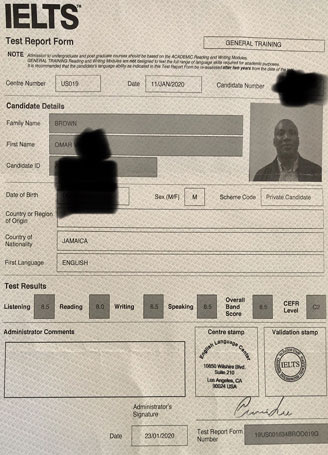
Best IELTS test result January 2020 Band 8.5 in IELTS

Omar said:

“This was my first time taking the exam. I registered for the January 11th exam on December 6th. My band goal was 9 overall. I thought I could just walk in and take the exam without any major time investment because I viewed it as another typical standardized exam.

It wasn’t until December 18th while researching the format of the exam, that I saw where people were complaining about its difficulty and numerous repeated low band scores (even for native English speakers). This made me panic a bit; therefore, I went on a deep discovery of how that could be.

I quickly learned that the exam was nothing like I “imagined”. With that being said, I ordered 3 books to help me, asked specific questions that I was uncertain of regarding the exam designs, and psyched myself that I will find out what could cause the phenomenon of low band scores.

As of December 20th, I made it my duty to do at least 1 complete Listening and Reading practice test per day, with one rest day. I separated the sections of the tests (because I realized that they progressively went from easier to harder as you completed questions 1-40). I tracked the sections that I struggled with most and noticed that there were certain sections that I repeatedly struggled with (sections 2 and 3) as well as the T/F/NG or No/Yes/NG. I then understood I was good at the hardest and easiest questions (4th and 1st section, respectively).

What I did after learning from my mistakes and the trend of why I was struggling on those sections and questions, was that I decided to complete those parts first in the reading test and spend more time on them, than the other parts. This strategy can’t work with the listening, so I forced myself to listen more keenly in those areas for any traps and specific details.

For the Writing and Speaking tests, I barely did any practice. It wasn’t until near the end (after the Christmas holiday) that I decided that I should not neglect those areas because I think I’m good enough. With the speaking, I just learned what the components are and what they’re looking for and how to convey uninterrupted speech dialogue. Please note, I do have experience with public speaking. But I also learned that IELTS had a different style and I had to revamp what I was taught as a professional. I still never exercised any practical speaking in preparation. Advice: practice speaking English in EVERY SITUATION. No matter how casual or with non-speakers. It’s better to then translate.

For the writing, I read model essays that were considered/labeled as Band 8 and Band 9. Then I asked what’s different from theirs and mine. I started to write one task 2 essay each day for 5 days and sought feedback on 2 of them in Facebook and WhatsApp groups. The limited feedback were vague and did little to help me see necessary changes for improvement. One person even responded and said that one of my essay at most was band 5 and gave no reason why. I knew that wasn’t true because I had reviewed the IELTS Task 2 rubric and knew my basic writing was at least a band 7, but with some errors could be a band 6. What I realized was that with every essay, the writer had a certain style and that’s something you cannot replicate. I stuck to my writing style and just learned what were some recommended things to pay attention to. Advice: Know and understand the components of the rubric and the descriptors.

On the day of the exam:

I wrote in ALL CAPS on the answer sheet for listening and reading.

I completed the second and third section of the reading first. I still made mistake of writing words instead of letters for a few of the answers (why I got an 8), even though I read the instructions clearly. Advice: It’s best to write your answer on the reading answer sheet immediately in the essence of time. This will help you remember if you need to write words or answer choices (A, 1, i etc.) as answers for each section. You may be able to come back and make corrections. Otherwise, if you did like me and make a mistake when transferring the answers from booklet to answer sheet you may mess up following the SPECIFIC instructions for answer format. A costly mistake.

For the writing, I did task 2 first and truthfully went in with a plan of how to approach each type of essay question. I quickly looked at the type of question. It was a “to what extent do you agree or disagree with this…”

I jotted down a plan:

1st paragraph – General intro sentence. Rephrased the prompt. Thesis statement with my answer.
2nd paragraph – 1st point to support stance. Explain it. Give example or illustration.
3rd paragraphed – 2nd point to support stance. Explain it. Give example or illustration.
4th paragraph – conclusion to tie in the two points and say how they strongly support the thesis statement without repeating verbatim what was already said.

Truth be told, I spent so much time deciding on two clear and separate points, that by the time I decided to start writing, time was already slipping away. Therefore, I just started writing and almost threw the whole plan out the window. What came to my mind as I write, is what I wrote.

I did pay attention to make sure I had great transitions, using connectors, mix of simple, complex, and compound sentences, and paid attention to my punctuation. I did not pay much attention to vocabulary or grammar while writing. It was in the editing/reviewing phase that I did that. I made sure not to repeat words and used appropriate synonyms to replace most. However, I did not try to remember those “advanced IELTS words” that were suggested. I wanted to keep my individual (personal) voice and writing style to make sure the points were easy to follow, thoughts flowed, and that they were concise.

I did task 1 next and I literally just wrote as if I was writing/speaking to a friend. I did not use any plan or fancy vocabulary. I just made sure I covered what they asked for in the task: “Invite a friend to a concert, tell them why they would like it, when and where will it be, and how do I think it will be.”

With time against me, I quickly reread it and only made punctuation edits.

The speaking test felt like the easiest. The examiner’s disposition was so sweet and positive. It made for a pleasant conversation. I watched her body language as cue to when I’ve said enough and when I should keep talking. I just spoke naturally, avoided long pauses, and stayed positive. It was so quick and I was surprised when it was over because I was genuinely enjoying the “talk”. That’s what it felt like. My advice here is do not overthink or get in your head to try and give “perfect” responses. There’s no one-size-fits-all here. Just be you and give it your best shot of holding a conversation. If I was to receive a 9, this is where I thought I deserved it most.

My advice

  • Know what level of English mastery is required of you to realistically obtain the band score you need.
  • Master the English language first before trying to master the art of tricks and tips. The exam is designed in so many ways to prove your proficiency level is that or lower than it really is. It is very hard to fool or trick it.
  • Don’t waste your money if you know you are not ready. Like any art, you need to be at a certain level to soar.
  • Review the rubric for writing tasks and make sure you are unbiased about your writing.
  • Do not try to copy someone else’s writing style. It will come off as disingenuous and robotic.
  • Practice, practice, practice and note your weaknesses and strengths. Then strategize how to improve by learning why you got what you got wrong; especially for the objective sections (Listening and Reading).

    Note: if you are constantly getting the same range of raw score for reading and listening during the practice test, that’s the best estimate of your band score. Try to improve your English more first.

Use the time that you may worry or search for tricks to practice instead. The only way to get better at anything is to take action. Example: simply thinking about losing weight or researching how to lose weight won’t result in you losing weight.

Don’t be confused by the plethora of experts with conflicting views for what is required by IELTS. Take some of those advice with caution, as you may end up confusing yourself with too many different styles and varied recommendations.

Have confidence. But do not be cocky or biased about your English language aptitude.

PS: Although I prepped in 3 weeks, please remember that your situation will be different from mine, because we are all different. For that reason, what works for me may not work for you and vice versa.

Best of luck in your endeavors and may your results truly reflect your investment.”


https://ift.tt/3czbe9b
from IELTS-Blog https://ift.tt/38uIJX4
via IFTTT

Tuesday, 3 March 2020

IELTS Speaking Band 6 Full Test Video with Examiner’s Feedback

It’s not too hard to estimate your IELTS score in Listening or Reading – all you need to do is take a practice test and count how many correct answers you had. But how do you find out your score in Speaking? Here’s a hint: you need to get someone to help you, which is exactly what Arun in this video is doing. And it’s a good thing he got an early Speaking assessment, because his Speaking score turned out to be Band 6, which is lower than the score he needs. So this experience saved Arun from taking the IELTS test too early and wasting his money, and he also received a list of things to work on, plus suggestions how to deal with his weaknesses and increase his score.

In the video you’re about to watch Arun, an IELTS test taker from India, is answering typical IELTS Speaking questions. You can see the breakdown of his score by 4 IELTS criteria (Fluency and Coherence, Lexical Resource, Grammatical Range and Accuracy, and Pronunciation) at the end of the video, and also in his evaluation report here.

The questions are shown on the screen while Arun answers them. You will see that every question has a number (Q1, Q2, etc) and the examiner in his evaluation report is referring to Arun’s little mistakes in every question. It’s great to watch the entire video first, and then go back to the specific questions as you read the evaluation report. It will help you understand what exactly the examiner means when he says something like

Q7 – ‘as well as’ not used correctly: ‘we can go by bus, as well as we can go by car’ should be: ‘we can go by bus as well as by car’’; ‘why I like this restaurant’ should be followed by the verb ‘to be’ – ‘why I like this restaurant IS because’.

Download Arun’s speaking evaluation report here

It would be a good exercise for you to make a list of any mistakes or inaccuracies you hear while watching this video, and then compare your notes to the examiner’s feedback. What would you do better? What vocabulary could you use instead?

Try and answer the same questions in your own words, and perhaps even record yourself. It will provide an opportunity to listen to your pronunciation and see what needs work.

If you’d like to get your Speaking evaluated just like Arun did, you can – go here to learn how.


https://ift.tt/1yra8oP
from IELTS-Blog https://ift.tt/2IiU55y
via IFTTT