Thursday, 22 August 2019

IELTS report, topic: Bar chart and pie chart describing residential water consumption (from IELTS High Scorer’s Choice series, Academic Set 1)

This report was written by a student on a topic from IELTS High Scorer’s Choice series, Academic Set 1 book (page 97, reprinted with permission).

You should spend about 20 minutes on this task

The bar chart below shows the average Australian water consumption in selected cities for last year. The pie chart shows the distribution of Australian water consumption for last year.

Summarise the information by selecting and reporting the main features, and make comparisons where relevant.

Write at least 150 words
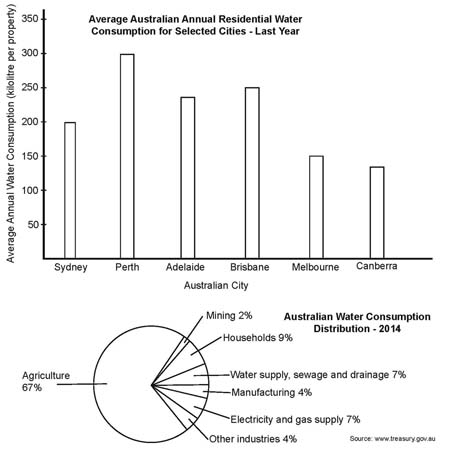
Bar chart and Pie chart describing residential water consumption (from IELTS High Scorer's Choice series, Academic Set 1 book)

Answer

The bar chart illustrates the average Australian water use in 6 selected cities for last year, while the pie chart describes the share of water each industry consumed in 2014.

Overall, Perth had the highest average water use for last year with 300 kilolitres per property, followed by Adelaide and Brisbane with 240 and 250 kilolitres property respectively. On the other hand, Melbourne and Canberra showed the lowest average water consumption of 150 and 140 kilolitres respectively.

Taking a look at the distribution of water use by industries, we can clearly see that Agriculture took over two thirds of the entire consumption , followed by households . Water Supply, Sewage and Drainage industry consumed the same amount of water as the Electricity sector, 7%. In the same way there was no difference between the consumption of Manufacturing and Other industries, with both sectors using 4% of the national water supply. The smallest user was the Mining industry, accounting for just 2% of Australian water use.

To conclude, the city of Perth and the Agriculture industry had a major impact on the usage of Australian water.

The information on two charts was covered in this well-developed response. The data is grouped well and a wide range of vocabulary and sentence structures was used. The minor grammatical mistakes (mouse over words underlined in blue shows the corrections) could have been caught at the final proofreading stage. Overall, this report seems worthy of Band 8.

Click here to see more IELTS reports of band 8

the right preposition to use here is “per”, not “of”
the preposition “at” is missing here – “at 67%”
the preposition “at” is missing here – “at 9%”


https://ift.tt/33P9zrI
from IELTS-Blog https://ift.tt/2TUIj6E
via IFTTT

IELTS Speaking test in Namibia – August 2019

The IELTS Speaking questions below were shared by M, who recently took IELTS in Namibia:

Speaking test

Interview

– What is your full name?
– Can I see your ID?
– Where are you from?
– Do you work or study?
– What do you do?
– What do you like about your job?
– What can be improved at your work?
– Do you think of changing this job in the near future?
– Do people in your country drink coffee?
– Why is that?
– What do you offer to visitors, tea or coffee?
– When was the last time you drank tea?
– Why is it so?

Cue Card

Talk about a day off you enjoyed recently. Please say

– When and where was it?
– What did you do there?
– Why did you enjoy it so much?

Discussion

– How can technology influence relationships?
– Will people have more free time in the future?
– How does technology help people to relax?
– How can technology save time?


https://ift.tt/1yra8oP
from IELTS-Blog https://ift.tt/2TU16Ph
via IFTTT

Wednesday, 21 August 2019

IELTS test in Pakistan – August 2019 (General Training)

Below are the IELTS questions from a recent exam in Pakistan (thank-you to N for sharing!):

Listening testIELTS test in Pakistan

Section 1. Lifeguard application form.

Section 2. Formation of planets.

Section 3. Don’t remember.

Section 4. About floods.

Reading test

Passage 1. About a resort and its facilities.

Passage 2. About different sleep disorders.

Passage 3. New ways to overcome flood problems.

Passage 4. Technological advances in Bio-robotics.

Writing test

Writing task 1 (a letter)

Parents of your close friend are coming to your area for a visit. He/she asked you to suggest some places for older people to visit. Write a letter to your friend and include the following:

– Suggest some places his/her parents could visit.
– Recommend a place for them to stay.
– Give some other ideas for their visit.

Writing Task 2 (an essay)

Some people believe that to become successful in sports one should have a natural talent. Others think that perseverance and practice are a crucial part to success. Discuss both views and give your own opinion.


https://ift.tt/2L1zhjY
from IELTS-Blog https://ift.tt/2MuGcph
via IFTTT

Tuesday, 20 August 2019

High scorer with IELTS Band 9 in Reading and Speaking shares exam techniques

We never forget how generous our readers are, because times and times again they remind us what a wonderful bunch of people visit IELTS-Blog.com. First they come here to study and ace their exams, and then they come back to help others!

Band 8.5 in IELTSToday we are sharing with you the tips from Ujjwal, a winner of our July round of IELTS results competition. Ujjwal is from India and his mother tongue is Bengali. His Overall IELTS score is 8.5 with two perfect 9’s for Reading and Speaking. Here is what Ujjwal recommends that you do to score high in IELTS.

Ujjwal said: “Thanks for the recognition. Please find my briefing on techniques and suggestions for scoring high in the IELTS.

Listening

This is a deceptively difficult part of IELTS. Thorough preparation is required in case you are not a very active listener. Over time, I learnt that a well thought strategy is required to master this part. My strategy was to practice in a test-like environment. I listened to audio recordings on a speaker and had a separate Question sheet and Answer sheet (I made printouts from online materials). Scanning the questions quickly and thoroughly is the key. I practiced this part a lot. A good week’s practice and a constant score near your target score should help you sail through.

Reading

For this part reading newspapers and articles daily can make a difference. Paying attention to each part of the text is key. It is important to remember answers are taken from the texts in the section, so underline the key word(s) while reading. Dedicated test practice is required for at least 2-3 weeks for a perfect score (I was fortunate to get one!)

Writing

This is by far the most dreaded part of the test, especially if you are not a scholar in English or a writer. The key is to practice over and over using some known topics. Getting your written responses evaluated, such as with the help of IELTS-Blog.com can go a long way. My confidence and scores got a permanent boost with practice and evaluations from experts. Practicing on the list of broader 5-6 topics such as health, money, environment, education along with relevant vocabulary is key to scoring high in the essay section. Practice regularly to keep the word count close to 180 and 280 for writing task 1 and writing task 2 respectively.

Speaking

Having knowledge on a list of topics is a must for this section, however, what can make a difference to the score is your flow and overall delivery. Keeping it natural and friendly is key. Practice is required to open and conclude the responses. Long answers and higher speed of delivery can be detrimental. Just speak as you would to your colleague with the above points in mind and a desired score should be a cakewalk in this section. A point of caution, however, is it is subjective to an extent since it is evaluated by a human so practice is required to deliver your responses naturally, correctly and confidently.”

We would like to thank Ujjwal once again for these tips, and wish him lots of success in the new chapter of his life!


https://ift.tt/2J0QBGf
from IELTS-Blog https://ift.tt/2ZjcdTj
via IFTTT