Thursday, 4 July 2019

IELTS Speaking test in Manila, Philippines – June 2019

When H took the IELTS Speaking test in the Philippines she was asked the following questions:

Speaking testIELTS test in the Philippines

Interview

– What is your full name?
– Can I see your ID?
– Where are you from?
– Do you work or study?
– What do you do?
– How do you get to work?
– Do you prefer a car or public transport?
– Where do you live now?
– What are the problems in your neighbourhood?
– Can they be easily solved?
– What would you do to end them?
– Let’s talk about photography.
– Do you like it?
– Do you take many pictures?
– Do you prefer using a dedicated camera or a smartphone camera?

Cue Card

Talk about a person that you met in school or at work. Please say

– Who is he/she?
– Where and when did you meet him/her?
– What is so special or interesting about him/her?

Discussion

– What problems do you have at work?
– What leisure activities do you have at work?
– Is there competition at your workplace?


https://ift.tt/2XqiHi2
from IELTS-Blog https://ift.tt/2JbNdbC
via IFTTT

Wednesday, 3 July 2019

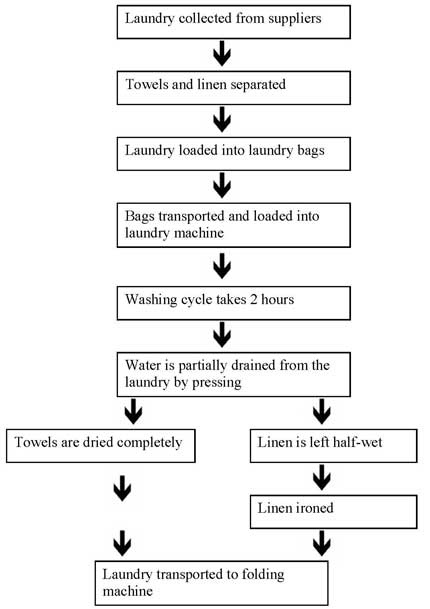
IELTS Report, topic: Flow chart describing how laundry service works (from Target Band 7 book)

This report was written on a topic from “Target Band 7” book (page 45, reprinted with permission).

You should spend about 20 minutes on this task

The flow chart below explains how laundry is handled.

Using information from the flow chart describe the laundry process.

Write at least 150 words

Flow chart describing how laundry service works, from Target Band 7 book

Answer (approx. IELTS Band 7 level)

The flowchart illustrates how a commercial laundry service works. There are nine or ten steps involved in handling laundry, and the number of steps depends on the type of laundry.

After laundry is collected from suppliers, it is separated into towels and linen. Each type of laundry is loaded into laundry bags, which are then transported and loaded into a laundry machine. Following that, the washing cycle begins, and it takes two hours from start to finish. After washing, water is partially drained from the laundry by pressing, and the next stage is different for towels and linen. Towels are dried completely, whereas linen is only partially dried. The half-wet linen is then ironed. In the final step, laundry, including both towels and linen, is transported to the folding machine.

Overall, the entire process is very similar for the two types of laundry. The only step that differs relates to the level of dryness of the laundered fabric.

Click here to see more IELTS reports of band 7


https://ift.tt/2XhnqCB
from IELTS-Blog https://ift.tt/2J7Tsgz
via IFTTT

Tuesday, 2 July 2019

IELTS test in Turkey – June 2019 (Academic Module)

Our friend E took the IELTS test in Turkey and remembered the following Writing and Speaking questions:

Writing testIELTS test in Turkey

Writing task 1 (a report)

We were given some pie charts showing Australian agricultural products and their contribution to income in 2002.

Writing task 2 (an essay)

Government should spend money to encourage the development of sport and art for school students, rather than supporting professional sports and art performances for general public. Do you agree or disagree? Give your own opinion.

Speaking test

Interview

– What is your full name?
– Can I see your ID?
– Where are you from?
– Do you work or study?
– Where do you study?
– What do you study there?
– Why did you choose this place to study?
– Is this a good place to study? Why?
– Do you think it is necessary to learn how to drive?
– Did you travel by taxi recently?
– Do you own a car?

Cue Card

Talk about something you needed, that you have received recently. Please say

– What is it?
– Why did you need it?
– Who gave it to you?

Discussion

– How did you feel after receiving it?
– Do you think people buy things they don’t need? Why?
– How can advertisements influence people’s shopping habits?
– Have your shopping habits changed compared to the past?
– Are advertised products really worth it?


https://ift.tt/2JoLGxY
from IELTS-Blog https://ift.tt/2Xnu2Ew
via IFTTT

Monday, 1 July 2019

IELTS tips from a doctor who scored Band 8 – sit up and take notice!

Band 8.5 in IELTSDr. Mir Kant is an Indian citizen who works in Saudi Arabia at present. He recently took IELTS and got Band 8 overall, with 8.5 in Reading and Listening! This beautiful score secured him a winning 1st place in our monthly IELTS results competition, and in his winner’s interview Dr. Kant shared his best tips for success with all IELTS test takers out there, studying for their exams:

LISTENING

Practise listening to BBC Radio Programmes, IELTS Podcasts, Ted Talks and ask yourself questions based on IELTS Listening Practise tasks available online. Also try listening to different English accents such as British, American, Australian, etc to get familiar with all the various pronunciations.

READING

Get used to reading many different academic texts, especially newspaper editorials, for instance those from the Guardian (UK), Wall Street Journal, etc and then try to see how much you comprehend. Learn the techniques of skimming and scanning to increase your speed. Practise using mock tests.

WRITING

This is the most difficult part of the IELTS test and more time should be devoted to prepare for it. Practise Writing Task 1 and Task 2 separately, as these are different and need special skills to get a score of at least 7.

The key here is to practise writing as much as possible, download a mock answer booklet of the IELTS and write in pencil on it on the topic questions available online; use a timer to complete both the tasks in one hour only. Count the words also at the end to have an idea of your word count and writing speed.

Also, improve your vocabulary, use some less common words, work on grammar and punctuation. In the exam write in paragraphs and definitely do the Writing Task 2 first and only then Writing Task 1, as the former carries more marks. Also keep a goal of writing around 290 words for Task 2 and 180 words for Task 1.

SPEAKING

The more you speak in English, the more confident you will become. Try to speak only in English at home and at work. Speak in front of a mirror, when you practice answering IELTS Speaking questions, for instance introducing yourself, describing your job / studies, your hobbies etc. Practise with a friend as speaking partner (who may or may not have an IELTS test too). Listen to speeches from native English speakers on TV or podcasts and notice how your speaking is different from theirs, and try to correct that. Improve your pronunciation and accent, wherever possible. Confidence is the key here and try not to speak too fast or too slow.


https://ift.tt/2J0QBGf
from IELTS-Blog https://ift.tt/2Xel5s9
via IFTTT